Rss Feed
    Showing posts with label reviews. Show all posts
    Showing posts with label reviews. Show all posts
  1. Patience

    Wednesday, 20 August 2014

    I was stocking a cupboard for work recently whilst we were on a residential. After going in and out of this cupboard a handful of times I grew to hate it with a passion. Well, not the cupboard itself, more specifically the door. It had no handle, and there was something wrong with the closer, so it took about a minute and half at least for the door to close. 

    A colleague of mine who hasn't known me very long stood and watched me go a few rounds with this door before making a very astute observation - 

    You really haven't got much in the way of patience, have you?

    And he would be absolutely right. Patience might be a virtue, but it really isn't mine, unfortunately. What I learned over the past few days though is that using a CGM seems to require a certain amount of patience, not least for me, the patience of waiting for start up day to arrive.

    I was slightly apprehensive when it came to actually inserting the sensor, as I'd read in various places that whilst the sensor itself was comfortable to wear once it was in, the inserter resembled a harpoon and it was quite painful to go in. 

    I was quite intimidated by the inserter when I got a look at it for the first time, and actually, yes it did hurt somewhat going in. It didn't even make my top 20 of 'things that have really hurt', but I believe my words at the time were 'my, that's not particularly pleasant', which probably does rank in the top 20 most stereotypically English reactions to things I've ever had. My experience though was that although I've never had problems inserting pump sites, I found that inserting that putting in the sensor on my abdomen was somewhat tricky having, well...amble breasts which made seeing what I was doing...difficult.

    Hey ho.

    After that initial ouch though, it turns out the sensor is, so far, comfortable to wear. It's not like the limited experience I had with the Medtronic iPro two years ago, where I couldn't sleep because I found it so uncomfortable. To be quite honest, I've barely noticed it's there. Massive thumbs up.

    Watching that blue bar count down to nothing was difficult. Like I said, I have no patience. I couldn't wait to see how this could help me in the time that I had it.  

    One thing I was that the first 24 hours are a real learning curve for the sensor as it learns to interpret what your body was telling it. I was warned - don't over-calibrate and confuse it. Have patience. Yikes. That was a test and a half. I did well to only calibrate it (I think) once more than the recommended amount, because it was at least 5mmol/l (90mg/dl) away from the scores on my meter. But by the time I got to day two, it was pretty much perfectly in line with my meter. 

    I can see why some people would find the constant stream of information overwhelming. I think you need to be the right sort of person to find it helpful. I know I've had to sit on my hands a bit to stop me from jumping the gun and reacting too quickly. I'd been given the advice to not over-correct and trust my IOB. For the most part, it seems to have worked, but when you see two arrows up or down you want to intervene immediately. It's been fascinating to see what different foods are doing to me, and reassuring to see that for the most part I seem to have been doing things right. For the most part. I don't pretend to be all knowing, or getting everything right, or that everything comes easy. That would be wrong and a whole stack of lies.

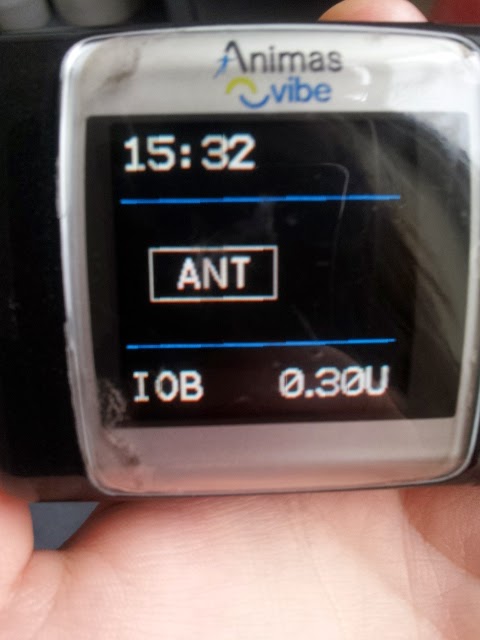
    Something that I did find confusing was the appearance of this...


    This kept turning up randomly. Particularly, for some reason, any time I walk into the bathroom in my house. Supposedly I need to bring the pump closer to the sensor. I only ever take it off to shower, and I've taken to leaving it on the shelf by the bath then. But one day, these warnings kept turning up all the time. My reaction...


    This, and other questions proves why the DOC is invaluable. I haven't been throwing as many questions out there to the Twitterverse in a good long while. Probably not since I started pumping in 2010 - it's very reassuring to know that people out there will help with all your worries, niggles and ponderings when you're breaking new ground with your D management. No-one was able to actually work out why I was getting so many ANT readings, or why my bathroom appears to be the magical land of no reception. But knowing that people cared was a massive help.

    So it's so far so good. I'm not wanting to confess the depths of my love affair with Dexcom just yet, as I'm not sure I'll be able to cope with the divorce process of when I have to give it up. 


  2. Getting armed and ready

    Monday, 26 September 2011

    Let's just get this said right off the bat - diabetes sucks. It isn't any fun, and it's not something we ask for. I'm riding at a 'lovely' score of 14.8mmol/l (266) as I write this - I'm not exactly in the best mood, as you can imagine. However, I'm trying to put a positive spin on things as best I can. 

    I read the '15 measures' article from Diabetes UK the other day, and had to stop and think some. If you've not read the article (which I suggest you do, if you haven't), the basic premise is that there are 15 basic health checks that people with diabetes in the UK should get every year. What was rather horrifying was the statistics provided of the sheer thousands of people who were failing to access basic tests to help educate and prevent complications. Education and basic tests are far more cost efficient than treating complications later down the line. Really, there is no excuse not to be offering these checks to people. 

    I'm lucky. I really am. I've been offered, and taken up several diabetes education courses. Of course I'm pro-active about my health and my diabetes education. Not everyone is. But through asking, and I mean simply asking - I didn't have to beat down any doors - I've accessed carb counting courses, courses for 'newly' diagnosed people and pump training. I am aware how lucky that makes me. Not every area offers these things. On the whole I've never had to fight for my test strips. I pray that never changes. Through being educated, and given the right resources, I can know that my sugars were at that 14.8. I know how to correct and what to correct by, rather than leaving it up there. This has to be a good thing, surely? This is the application of preventative measures! This is how you enable people!
    On the flip side,though, the problem with having all these checks done is that sometimes the results tell you something you really don't want to hear. I reference you back to the whole 'chubbygate' situation. I didn't want to hear that. It hit a raw nerve for me. But my consultant wasn't to know how my weight has been an issue for me for pretty much as long as I can remember. And I'm trying to do something about it. You bet I am. It's not easy though, and I'm sure many people out there can relate. 

    It's not just chubbygate though. I've been going round and round in my head about how I was going to bring this one up. I don't want to make something out of nothing, but it got to me. This is going back over a month, to the end of July. I had just got back from working a week long event as part of my job. Believe me when I say I was tired when I got back home. I found a letter waiting for me at my door, which I knew from looking at the envelope was from the retinal screening service. I wasn't worried to open it - the rather lovely young woman who'd taken my pictures had said that it all looked fine at the time.

    The letter was saying something different. Minor background changes. Apparently nothing to worry about, and nothing that required anyone doing anything. We'll see you in a year. 

    I would very much like to meet the person who reads that letter and doesn't worry. I'm sorry, but they're not human. I was tired, it hit me from nowhere. I dumped my bag at the top of my stairs, lay on my bed and started crying. Was I going blind? Was this my fault? I'd only been at this whole diabetes game for just over two years, and I was already getting this letter? The one I wasn't hoping to see for another ten, fifteen, twenty years, if ever? Had I done this to myself? Could I fix it?

    Well, of course, I got past that eventually. And do you know what? Being upset was ok. I keep telling myself that. Staying that way, though, is just self pity. And no-one likes that person. I certainly don't. I've since been for a standard, 'real-person' eye test. Part of that was the non-drops version of the retinal photograph. I talked to my optician about what I'd been worrying about, and he talked me through everything. Seems that if it were his own eye, he wouldn't have been concerned; it's the sort of thing that can disappear as quickly as it came. Turns out I needed to get glasses for cinema and driving, which I wasn't expecting, but what can you do? Most of my family wears glasses (or should - but I won't go there), and it wasn't like I was completely shocked. That's 'real-person' stuff, and nothing to do with me and my D. 

    Getting that letter, and 'chubbygate' were a real punch to the gut. I didn't want them, and I didn't really see it coming. But in the long run, I'm probably the better for knowing. You can't see your way through the darkness, and you can't work with information you don't know. It hurts, and sometimes it feels personal, or like people are rubbing salt into the wound, but I've been thinking and asking myself lately whether I would rather not know these things, and carry on blind, or know where I stand and what I'm working with. Personally, I'd go with option B. So to anyone out there who might be reading this who isn't getting all their '15 measures', please do yourself a favour. Make some calls, knock some doors down. Be your own advocate and your own enabler. Get what is rightfully yours to inform yourself and arm yourself against a disease that, let's face it, sucks and isn't going anywhere. We need all the tools available in our arsenal, so let's make sure we get our hands on them.


  3. Confessions of a Pump Ignoramus

    Saturday, 8 May 2010

    A fortnight ago, I was fortunate enough to go down to London to take part in festivities for the second birthday of the fabulous Circle D. I had a really wonderful time, despite feeling very rough. The sun shone, and I got to meet some fabulous people, including Northerner from  'Poems from Active Diabetics', Tom from Diabetes Dramas et al, and Siobhan from Click of the Light. It was about as close to a UK Dbloggers meet as we could hope for, really, when it was actually for something else!

    Tom has recently become the (extremely) proud owner of an insulin pump. The last time we met, which was in York in March, Tom had said that he would bring me an infusion site to try wearing, so that I could see what I thought of the whole thing. 

    Well, he did. And we filmed it, whilst getting the dirty stink eye from a woman opposite us. Siobhan is doing the camera work, and I ask you to forgive me for the following:

    A: Being extremely nervous
    B: Laughing rather hysterically
    C: Being a complete wuss.


    The London meet in itself was interesting. I had never had the opportunity to see an insulin pump before. So it was very educational to meet several people there who were all more than happy to show me theirs. On the whole, they were smaller, lighter, and more discreet than I had anticipated them being. I have very small hands, and yet most of them fitted in my palm.

    So at the end of the day, I went away with this on, and proceeded to leave it in for the three days that I'd been told was appropriate. 

    It was a very strange experience. After Tom had put the site in, it didn't hurt, like I thought it might, rather I found it itchy. I don't know whether my skin didn't like the adhesive on the tape, but it itched. 

    Tom had also given me a shower cap for it, so I wasn't wearing the tubing attached to nothing. It would have been another thing I would have been interested in doing, but wearing the tubing attached to nothing just seemed stupid. So I kept the shower cap on. And I showered, and slept and went about my daily business with it on. I intrigued/freaked out/enlightened people (delete as appropriate for the different reactions) with the site. 

    I was terrified of getting the thing wet, or ripping it out accidentally whilst I was asleep. But neither of these things happened, as was proved by I woke up with it still attached, and showering was fine. But I was still conscious that it was there for about 70% of the time. I know that means that 30% of the time I didn't care, or completely forgot, and you would probably get over that if you were actually wearing a pump, not just flirting with the site. One other thing I would hope you'd get over is the urge I found to play with the site. Mostly taking the shower cap on and off. But then again, I'm a compulsive fidgeter. I play with keys, I chew and pull out my hair, and up until recently, I was a terrible nail biter. I don't know whether that would marry well with something like a pump that you shouldn't really fidget with.

    What I was really afraid of though, was taking the site out. I didn't have anyone to help me with that! Was it going to hurt? Could I do it 'wrong' and accidentally leave something in? I was all set to see if I could find something on YouTube to help me, but I thought I'd give it a go solo first, and seek help if I ran into problems.

    Well it seems I had built it up in my mind to be this huge thing, which it wasn't at all. It didn't hurt me any more than removing a plaster. I was surprised to see blood in it, but I don't know why. Makes perfect sense, really. The thing that really had me slapping my forehead and feeling like a prize idiot though, was the fact that what I was removing was actually NOT a needle. Of course it wasn't! But I had always believed that there was a needle inside the infusion site. Like I say, my contact with pumps had been virtually non-existent, and not being in active pursuit of acquiring one myself, I somehow had this misconception. Why would there be a needle? It would be far too easy for it to break off inside you, which would be perfectly horrifying. I guess that goes to show you that anyone can get the wrong idea about something, being as I consider myself fairly well informed on most things diabetes-related. 
    But will this experience, which allayed an awful lot of my fears surrounding pumps, convince me to seek one out for myself? I don't think so. I find the whole thing fascinating, I totally support those out there who are after a pump for themselves, and maybe in a couple of years I'll join them. I can see the pros. I'm getting tired of injecting, because my technique seems to have got a bit rubbish as of late, and I'm finding it hard to find a spot or an angle which doesn't hurt. Yet, I don't think I'd be ready any time soon to make the leap of being tethered to something 24/7.

    I'm currently taking part in a course at my hospital called 'Living With Type 1 Diabetes' (catchy!), and apparently we're going to get a chance to have a look at some pumps, and talk to a couple of people using them. So my pump education continues!

  4. Review: Contour USB (update)

    Monday, 5 April 2010

    Just to show that we can all be proved wrong, I must stand corrected. In my earlier review, I said that the Contour USB didn't have the function of lighting up where you insert the strips. Turns out that it does, and I'd just been doing it wrong. I had assumed that it would turn on automatically. What you need to do, whilst the meter is turned off, is press once, wait a second, then press again. Two quick presses will turn the light back off again. 

    So that's another feature! Thanks for those who pointed out what I was doing wrong. Always glad to learn something new.


  5. I've been holding off on this a little while, because I wanted to give it my full attention. I didn't want to rush into a review without considering what I was going to say.

    Overall, I'm impressed with all the great features that the meter offers, and I'm going to try and be pretty thorough in this review! You might want to grab yourself a drink before you start reading.

    I have been extremely excited about the release of this meter. From everything I'd heard from those in the US, and those who had seen advance versions, I was expecting great things. So when Bayer contacted me and asked me if I would like a complimentary one in exchange for an unbiased review, I jumped at the chance.

    I will say that I haven't been using the meter long, and that my opinion might change as I use it long term, but these are my impressions at the present time.

    Blood Glucose Meter
    Opening the box, I will admit that I was expecting the meter itself to be smaller. Possibly because I hadn't really seen it pictured in relation to anything. Yet, it's still markedly smaller than my Contour, which love it as I may, I have always found to be a touch on the bulky side.

    Appearance wise, it's very sleek, and if you were conscious of bringing out your meter in public, this would be a very sensible choice of kit for you. Streamline and smart, you could easily mistake it for an MP3 player or similar. I would have liked the option of a covering film for the screen, to prevent scratches, or a silicone 'skin' to protect it in a similar vein to what I use on my MP3 player. It's not a drawback to the meter, but perhaps it is something Bayer could think about offering further down the line - I'm sure that there would be a market for it - everyone likes the option of making thing customisable.

    Along with the meter, you get a case, which looks as though it will be hard-wearing. I have found it difficult to zip up without the meter popping out, but that could just be me, more than a fault in design! Along with the case, you get a pot of strips, testing solution, a USB extension lead, which is a nice extra touch (you can also register for a free wall charger), and the Microlet 2 lancing device. It also comes with multicoloured lancets, which excited me more than should be appropriate for a twenty-five year old woman!

    I've not exactly been shy of complaining about having difficulties with my lancing devices as of late. When I upgraded my old Contour to a newer version, I got a Microlet 2 lancer. At first I was extremely impressed with it, but it got more and more painful to use as time went on. I think the spring action it broke down, and lost the initial power that it had. Perhaps I have a faulty unit, because this new one has been excellent so far. It's not painless - I don't think lancing ever will be. However, it has been pretty consistent in getting blood. If this continues, I can keep this as my primary lancing device, and keep the One Touch Comfort in reserve for lancing emergencies.

    One thing you can't say is that you're not provided with enough literature. I was slightly overwhelmed with the amount of paperwork that there was included. If I had been someone else, I might have found that a touch intimidating, I think. However, if you're fazed by the amount of potential reading, there is the option of a 'Quick Reference Guide', which is mostly one sentence style instructions, each illustrated. If you're just wanting to get started before delving any deeper, or just want to test with no other features, then this is really helpful. Yet, I have to feel that if all you wanted to do was just test and turn off again, then this is a huge waste of such an intelligent meter.

    Testing is pretty straightforward. Insert the strip, and follow the instructions on the screen. There's a backlight function, which will inevitably be very useful. I haven't tried testing in the dark yet, so I'm not sure whether the point of strip insertion lights up as well. If it doesn't, I may well find putting strips in when it's dim quite difficult, because I've missed a couple of times in broad daylight. That's more to do with rubbish hand-eye co-ordination than anything else though.

    The meter is notably polite! It explains everything in a nice manner, even if you're doing something wrong. I'm also impressed with the ability to 'mark' your results, not just with pre and post meal markers, but with options such as 'don't feel right', 'stress', and 'activity'. The number of times I've tried to scribble notes like that against my logbooks in the past make that a very attractive feature.

    The instruction manual lets you know that if you get an error code whilst testing, you'll still get the error code on the screen, but you'll also get an explanation of what the code means, rather than having to go look it up. What a fantastic idea! The only ones I can ever remember are that I've put the strip in the wrong way, or that I've not given enough blood, so anything other than those completely stump me. Should you also get a particularly high or low reading, the meter tells you to wash your hands and retest, and then should you get a similar result, it will tell you that you need to follow medical advice. I really like this, as it gives room for error. You can also delete any false readings, which is great for not messing around with your averages.

    It comes pre-set with standard targets for pre and post meal levels. Personally, I found the levels to be on the high side of where I'm comfortable. Not a problem though, as I can change them quite easily. Alarm wise, you can customise your post meal testing alarm. What's really great about this is that you can set the alarm per test, in increments of fifteen minutes. I love that, I really do. The alarm also repeats itself in a kind of 'snooze function' - great for when I'm at work and I frequently don't hear the alarm going off.

    You can see trends on the meter, which is useful for a quick view, but you're far, far better off taking advantage of one of the meter's biggest selling points - Glucofacts Deluxe.

    The press release I was sent describes how the software 'translates up to 2,000 individual blood glucose readings into meaningful trends and patterns, giving users an unprecedented level of access into their own unique diabetic profiles and empowering them to become 'experts' in their diabetes'.

    I'm not suddenly wowed by the figure of 2,000 results being so huge. Actually I'm more curious at what happens with result 2,001 - I'd really like an answer over that. Perhaps someone from Bayer can enlighten me? Yet I would say that even with limited data uploaded onto the software, I can definitely see that having my results translated into graphs and trends automatically is a going to be a huge help. I've been doing this up til now with my logbooks and spreadsheets. Having this done by the meter as standard is a huge time saver, and takes the pain out of it for me!

    The software lets you see standard days, weeks and months. You can customise your 'time periods' in the day, which is great for me, as I'm much more nocturnal, so my morning starts later than the standard settings, and I can change that (although it is rather frustratingly fiddly!) to reflect how I actually live, rather than how the default person does.

    Charts also show you your percentages of time spent within your chosen targets, and on either side of the boundaries. By hovering over results on the logbook, you can also see any notes you made on the individual result, as well as the time and date. I haven't found a way of making more than one note against each result, which would be a great feature - if I don't feel right, and it's also before a meal, the ability to mark both would be great.

    There are also features I haven't explored yet, such as the ability to send results to my team. I think the trends and graphs will also become a lot more useful once I have more results stored.

    So on balance, what's my verdict? I like it an awful lot. For me, I think it is as close to a perfect meter as I can expect from what's on the market today. There are some features that I would like to see expanded on: multiple markers for results, a light on the point of strip insertion, but these are mostly minor gripes that I can see being ironed out for the mark two of this model. The only major downside I could see would be for someone for whom this much information would just be 'overload'. For those easily 'blinded by science', this might be terrifying. For those people, I'd point them towards the earlier Asencia Contour, because it has some customisable features, but not as many as to be off-putting.

    Personally, I think this will revolutionise the way I manage my blood sugars. I like to know what's going on, and this shows me in a way that I can digest. If you're not sure whether this meter would be for you, I'd seriously think about giving it a try, but only if you're planning to use the features, otherwise you might be better off with a simpler meter. I do agree that this has the potential to help people by 'empowering them to become 'experts' in their diabetes'. If it does, then that can only be a good thing. We all need a bit more empowerment sometimes. So all in all, I say well done Bayer. I can't wait to see what you come up with next.